Monday, May 31, 2010

Disappearing Island and Visitors

It was another fun week, as always. We're up to about 1,000 albatross chicks banded, and started the banding of the Bonin petrel chicks also. There's not many of them here though. We're also still banding red-tailed tropicbird chicks and will be for most of the year.
We also took a boat trip to the southern tip of the atoll, to Disappearing Island. It's there most of the time, but not always. The water is beautiful down there, so we had to have a look around. There are a few pictures below.
The Hi'ialakai stopped in again on its way back down to Honolulu. They're still doing reef surveys and more maritime archeological work on the shipwrecks around here. A few of the researchers and crew got to visit the island this time. They rarely get the chance to step on island, but the ocean swells were sort of high, making diving difficult, so they had a little extra time.
Other than that, we've got the usual stuff going on around here. Lots of chicks, lots of eggs of different species, and lots of noise from the sooty terns.

One of the small boats from the Hi'ialakai is dropping off a group of visitors to see the island.

Clockwise from left are Sarah, Dasha, me, Tammy, and Ruth with Disappearing Island above the waterspot on the left of the picture (photo courtesy of Caitie Kroeger).

Disappearing Island is relatively large right now but may be gone in a month or two, but then again, it may not.

An old lobster trap still sits on the bottom near the island. The black fish are Achille's tangs, and the yellow one is a relatively recent introduction to the Hawaiian Islands (1958). It is a bluestripe snapper. My underwater camera is off for repairs, so I borrowed Caitie's camera to take all of these pics.
Here's a chevron butterflyfish. These are very rare in the Hawaiian archipelago, but fairly common here because they only eat (genus) Acropora coral, commonly called table coral, seen here just behind the fish. Acropora coral is only common in Hawaii at French Frigate Shoals.

Here are a couple more Achille's tangs, yellow tangs, and ornate butterflyfish about 20 ft down.

Here's the reverse view that the volunteers see out their windows.

The wedge-tailed shearwaters really like to nest in the boat house. It's far nicer than their usual burrows. It makes the boat difficult to take out, and we frequently have to scoot the eggs out from under the trailer tires. At least these birds are pretty good at knowing they are supposed to move. The albatross chicks just sit and snap at the trailer, thinking that that'll scare it away or make it turn around.

Sunday, May 23, 2010

Population 11

The NOAA ship "Oscar Elton Sette" or Sette for short, got here on Wednesday and dropped off Shawn, Mark, and Darren to monitor the Hawaiian monk seals, and Tammy and Kristen to monitor the green sea turtles. We also had some crew and visitors from the Sette come on island for a quick tour. People don't get to stay long, but everyone enjoys it. The monk seals are finally starting to have more pups, and there are some turtles finally nesting, so the new crews are keeping busy. The volunteers have been banding a lot of albatrosses the last 2 weeks and it looks like they are about 1/7 done. We're banding the ones that are closest to fledging first and waiting on the fluffy ones to make sure they are going to make it.
Our next group of volunteers are coming on the Kahana in a few weeks, so I've been keeping busy getting orders ready for the next 6 month of supplies. I'll quit going on and you can look at some pictures.

Here is the close up of the Sette (the Hi'ialakai that stopped by last week is the same type of ship). I cropped the picture because I took it from our small safeboat and it was too crooked.
I'm taking the second group of visitors back to the Sette. Our volunteer, Sarah, is on the port side (left) and the rest are visitors from the Sette.

The turtle camp is being set up on East Island, since that is where most of the turtles actually nest. They'll go out every night to count, measure, and identify the turtles.

This is an odd little Ornate butterflyfish that I saw last week. It looks almost normal from this side (it's tail (caudal fin) pattern is a little strange).
Here it is from the reverse side. It may have been injured when it was young to get that pattern, or it may just be genetically different from the normal ones. It's hard to get a close look at them.

Like I said before, the turtles are all over the place. Here is another one that swam up to investigate me. And I didn't crop this picture, it was just close. My underwater camera quit working today otherwise I would have put another picture of Caitie taking a picture, this time of a reef white-tip shark that was about 8 ft from her. Oh well, maybe next time.

Sunday, May 16, 2010

Visitors

As usual in the Northwestern Hawaiian Islands, things don't work out quite as planned. The ship "Oscar Elton Sette" didn't show up today, because they had some issues and won't be able to make it for another few days. Another NOAA ship paid a visit to French Frigate Shoals though. The Hi'ialakai stopped by for a couple of days on their way up the chain. They were doing some reef surveys, archeological surveys, and collecting the receivers from the shark tagging project that was done here last year.
We finally found some seal pups this week. We had 2 on Trig island, 1 on East Island, and 1 on Little Gin Island. We only saw them from the boat with binoculars, so I don't have pictures. The turtles have also started nesting. I've only found a few nests so far, but there are a lot of turtles around, so I'm sure we'll be getting a lot more in the next couple of weeks.
The Hi'ialakai stays pretty far out to sea so they don't hit any of our reef. The "Oscar Elton Sette" looks the same, but I might have some closer pics of that next week.

This is one of the safeboats from the Hi'ialakai. They were checking to see what was growing on our seawall. It usually takes me a year or two to get the data that they collect on these trips. I normally get that when the publications come out, so don't ask me what they found yet.

This is a young bluespine unicornfish. It will grow a long "horn" in front of it's eyes as it gets older. The blue spines are just barely visible near its tail (on the caudal peduncle for those that know what that is). Those are the fish's defense. I have a couple of pictures of the adults, which get about 2 ft long, but they aren't as close so they aren't that nice to look at.
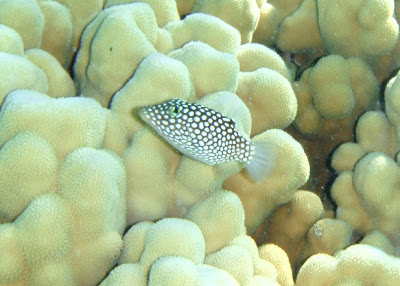
This is a Hawaiian whitespotted toby. These little fish are pretty much everywhere around here. I've been putting more fish pictures up lately because the water is finally calming down for the summer and we've been going snorkeling more often.
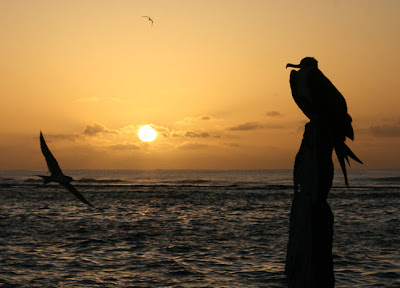
Again, another Tern island sunset.

Sunday, May 9, 2010

Population 6

We have one more week of Tern Island - Population: 6 Next weekend we are expecting the Sette with the 3 seal and 2 turtle techs. It'll be nice to change things up a little bit. So far there's still nothing for them to count though. We haven't seen any seal pups yet (although there are some that look pretty close to having pups) or haven't seen any turtles nesting yet (although they've starte digging some pits, but no nests yet). I'd guess both will happen this week.

Yesterday we started our albatross chick banding. We've got to band every chick on the island, so it'll take over a month to get them all. At least no one will be able to complain about not getting banding experience out here.

The weather has been nice out here so we've been snorkeling a lot lately. That's why I've been having the fish and turtle pics lately. I've got a few more from today. I should really quit taking pictures. My camera keeps track of how many I've taken and so far it's been 135,021 since I got it just before getting to Midway in June of 2007. I'm probably up over 140,000 counting my underwater camera. I still see something new every day, so I guess I'll keep it up.

This is the first albatross chick banded for the season. Only a few thousand left to go. Paula is holding it, Dasha is putting on the metal band and Caitie is putting on the field readable auxiliary band.
This is one of the brown noddies that frequents the front deck.

Every once in a while we find a dead fish up on the barracks roof. This flying fish was probably regurgitated by a booby, then picked up by a frigatebird, which was then chased by other frigatebirds, perhaps being stolen by a couple different birds, before finally being dropped on the roof. At least that's what usually happens.

This Japanese liquor bottle looks like it's been in the ocean for a while. It floated by while I was swimming.

Today was the first day I've seen one of these fish. It's a barred filefish.

This curious turtle who was wondering what my camera was.

Sunday, May 2, 2010

More fish, birds, and turtles

Again, it was another nice week. We got some good work done, like finishing up the seawall that I showed you last week. It's full now. Paula and the volunteers got the decks fixed up a bit and as usual, we counted and banded some birds. We also got some more snorkeling in. Now that the spring weather is here, the snorkeling is getting a bit better. Smaller ocean swells and less current make it a little easier to swim. In about 2 weeks we are getting a few more people on the island. We'll be getting 3 seal techs, that work for National Marine Fisheries Service (NMFS, which is part of NOAA) and 2 turtle techs. They will switch out camping on East island and monitoring the turtles over there. We'll have 11 people on island so we're keeping the water use down, so still going to have our minimal showers and toilet flushing. At least the ocean works well for cleaning off at the end of the day.

This is a bluestripe butterflyfish. They are a Hawaiian endemic fish. That's a convict tang in the background.
Sarah is pulling out a few weeds in front of the barracks.

I thought I'd show you the status of the albatross chicks. Some of them are still sort of small.

And some of them are getting close to being fully feathered.

The turtles are really starting to congregate on the beaches. Here's quite a few on East beach.

The Bulwer's petrels are coming back. These are the ones that sound like dogs barking. These 2 keep trying to nest in the tractor shed, which really isn't a very good spot.

I found a little plastic container this winter which had some dentures and a chain with a cross. It is engraved "Christmas - Richard with love - Mother 1963" This was one of my more unique finds.

Sunday, April 25, 2010

It's finally warm here

It's been pretty cool and windy here for the last couple of months. We're finally getting the warm breezes instead of the cool wind from the north Pacific. Cool is relative by the way. Cool for me means I sleep with a blanket, but I still wear shorts and short sleeves everyday. The volunteers all wear sweatshirts and long pants.

We finished our wedge-tailed shearwater mark recapture for the year. We caught and banded or read bands on over 600 birds. That's one of the ones that we do at night so although it's nice to see the stars, we are so busy crawling under the buildings and bushes that we don't get to look up until we walk back to the barracks. I think I mentioned before that the nearest lights are almost 500 miles away, so we get a pretty good view of the stars.

Another project we did last week was move big pieces of coral that are all over the island to the seawall. A lot of birds fall down between our double seawall and will die if we don't do our walk every morning and find them. By filling the space with coral, at least the birds can walk or fly out on their own. So hopefully, we'll have a lot fewer stuck or dead birds on that corner of the island.

Northwest corner of Tern Island seawall before filling with coral rocks.

Northwest corner of Tern Island after filling with coral rocks.


Here's a Potter's angelfish. They are pretty common and we see them alot while snorkeling.

We are starting to get a little island forming off of the SE side of Tern. It probably won't last too long and it gets covered up by high tide.

Just another shot of the sooty terns on Tern Island.

Friday night at the boat dock with a 30 second exposure. I hope this didn't get too pixelated when I shrunk it down to webpage size.

Sunday, April 18, 2010

Nothing Exciting this Week

This was a week of getting a lot of little projects done around the island (yawn!). We have mostly caught up with our bird studies, so now it's time to catch up on things like getting the rust off of tools and straps.

Ruth and Dasha are having a great time.

I usually don't show you all of the pictures of the tedius little maintenance work that we do here, because you can probably go to your neighbor's garage and see the same thing. But every now and then I should put these up so that volunteer applicants see that it's not all looking for marine debris with snorkel gear and interacting with the birds out here. But since you are on my blog looking to see things that you probably can't see in your neighbor's garage, here's some pictures from snorkeling last Sunday.


I haven't looked at what type of hermit crab this is, but it was a nice spot of color in the dead coral.

We don't see too many jellyfish around here (mostly Portuguese man-o-war's), but there were a couple floating around the boat dock last week. I took at least 30 pictures of these two and others, but this was the only one where they actually looked like jellyfish.

There is a boat hull upside down in about 15 ft of water and there are always some good fish around it. Usually a shark or two hiding underneath also. Here are 2 common longnose butterflyfish, a raccoon butterflyfish, and a bad angle on a Hawaiian dascyllus.

Here's another picture of Caitie taking a turtle picture. We see a lot of them this time of year since it is almost nesting time. The turtles are usually pretty curious underwater, and we try to stay pretty still to not bother them. They'll usually swim around us for about 30 seconds, then decide we aren't worth looking at anymore, then they go off on whatever business they had before we swam by.

Tuesday, April 13, 2010

Late Post

Sorry for the missed Sunday blog again, but the internet here has really been bad lately. I can only upload pictures late at night. Tonight we were out doing a mark/recapture study on wedge-tailed shearwaters and just got back in (it's 11:45 pm) so I was up. Normally this is past my bedtime. I think we only got around 150 of the birds caught tonight. So I think we'll have to go out at least one more late night to get the 600 birds we need.
Now that I have all of my volunteers here and my asst. mgr, I'm catching up on a lot of organizing and maintenance. It's nice to be able to be just a little bit behind, instead of way behind.
Everything is still beautiful out here. The green sea turtles are everywhere now and getting ready to start digging nests everywhere, and the seals are almost ready to start having their pups. The major bird nesting time is also starting for most of the species that are here, and the albatross chicks are getting their flight feathers in. I'll have to get you an updated albatross picture next week.
We had a good boat trip and saw some manta rays, no whales this time. So as usual, it was another great week (and a half).

Last week on our outer island trip, we saw a few manta rays. It's tough to get a good picture of them. This one was about 7 or 8 ft across.

We also saw a few spotted eagle rays surfacing near the boat house. Pardon my saying, but these are some goofy looking critters. This one is a female trying to get away from the 3 smaller males in the picture.

There are quite a few masked booby chicks hatching right now. They don't have feathers when they are born, so the parent will sit on them for a while.

This chick is almost to the age where the parent doesn't need to do this.

This masked booby has 5 eggs. I'm not sure they are all his eggs. It looks like the big one may be a frigatebird egg that it found. I'll keep an eye on this nest and see what happens.

Dasha and Ruth are fixing a band that was not closed all the way on this masked booby. If the bands aren't put on right they can catch on lines and branches and things. Notice the eye protection and leather gloves. These birds bite really hard.